Mortgage Refinance Tips for Smart Homeowners
 02.13.2026
Refinancing a mortgage means replacing your current home loan with a new mortgage to secure a lower interest rate, reduce the monthly payment, or access home equity (cash-out). Refinancing your mortgage usually costs between 2% to 6% of your total loan amount. However, strategically refinancing can reduce your monthly payments and create more room in your budget for other financial priorities. Whether you're hoping to secure a lower interest rate, shorten your loan term, or tap into your home equity, understanding the refinancing process is crucial before you begin.
What Is Mortgage Refinancing?
Mortgage refinancing simply means replacing your existing mortgage with a new one, often with better terms. Unlike your original home purchase process, refinancing involves paying off your current loan with a completely fresh loan agreement. Many homeowners consider this financial strategy when market conditions or personal circumstances change in ways that could benefit their financial position.
How refinancing works
The refinancing process is very similar to your initial mortgage application in many ways. First, your lender runs a credit check to evaluate your financial standing. After submitting the required financial documentation, you'll typically pay for a home appraisal to determine your property's current market value. The loan then moves through the mortgage underwriting process.
On average, completing a refinance takes between 30 to 45 days. Throughout this process, borrowers need to qualify for the new loan just as original mortgage, lenders will examine credit score (typically 620+ for conventional refinances), debt-to-income ratio, and home equity position. Most refinances require between 5% to 20% equity in your home, though having at least 20% equity helps you avoid private mortgage insurance (PMI) requirements.
Why homeowners choose to refinance
Homeowners refinance for several strategic reasons. The most common motivation is to secure a lower interest rate, which could reduce monthly principal and interest payments. Even a small rate reduction (0.1%-0.5%) can translate to thousands in savings over your loan's lifetime.
Another popular reason is changing the loan term, either shortening it to pay off the mortgage faster or extending it to reduce monthly payments. For example, if you have 22 years remaining on your initial loan, you might refinance a 15-year mortgage to save total interest costs.
Many borrowers also refinance switching from an adjustable-rate mortgage (ARM) to a fixed-rate mortgage, especially when an interest rate adjustment period approaches. This change provides stability against rising interest rates and makes monthly budgeting more predictable. A few homeowners use refinancing to access their home equity through a cash-out refinance for major expenses like home improvements, education costs, or debt consolidation.
Types of refinance mortgage options
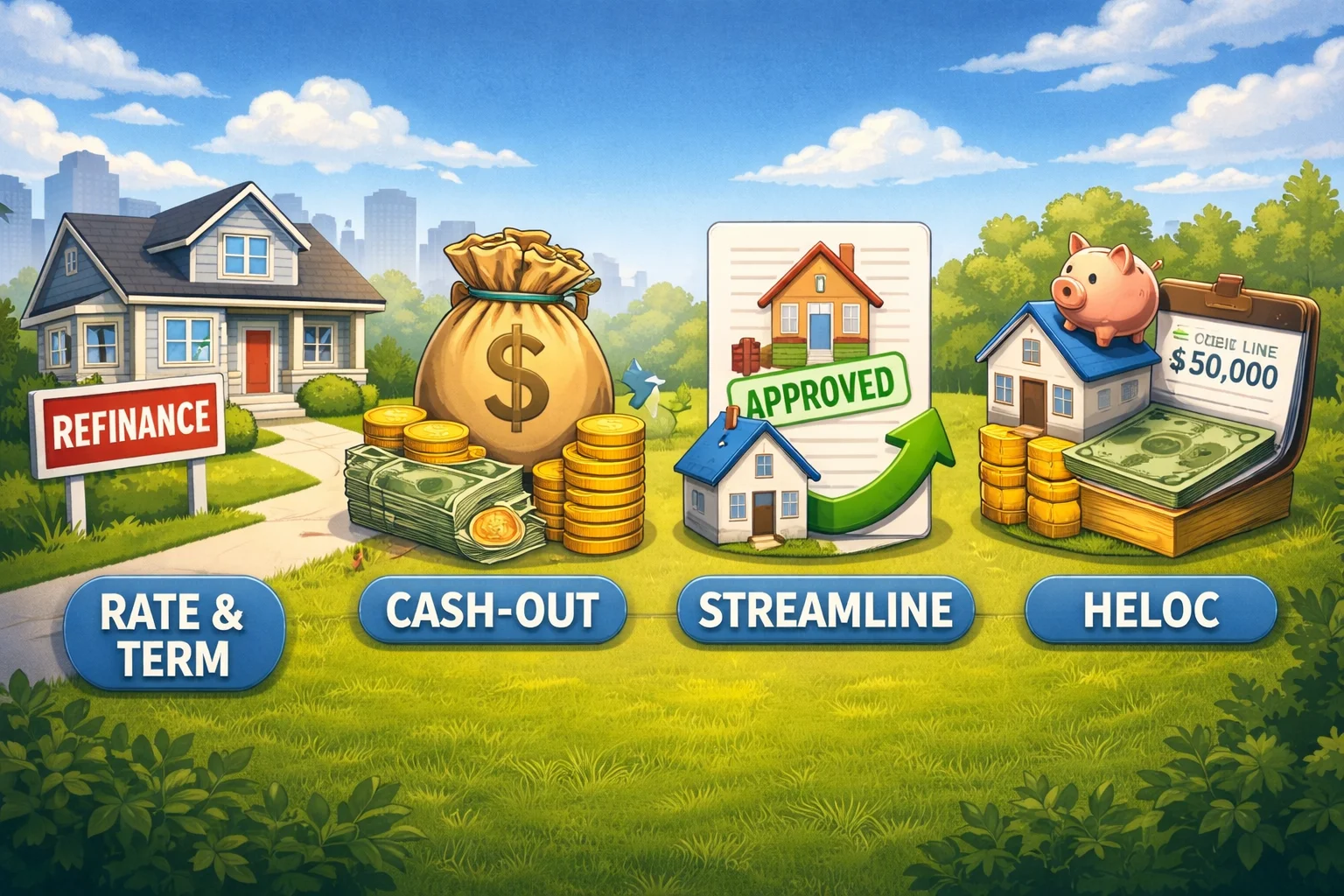
Several refinancing options are available to match different financial goals. Understanding these options helps you determine which refinancing approach aligns best with your financial situation and goals:
Rate-and-term refinance: The most common type of refinance, focused solely on changing interest rate, loan term, or both, without changing the loan amount. This option works well when interest rates drop or when you want to adjust your payment timeline.
Cash-out refinance: Allows you to borrow more than you currently owe by tapping into your home's equity, providing cash for various purposes. These loans typically come with slightly higher interest rates due to increased risk to lenders.
Cash-in refinance: The opposite of cash-out, where a borrower makes a large payment toward principal during refinancing to reduce their loan balance, potentially securing better terms.
FHA streamline refinances: It's a specialized mortgage refinance program for government-backed loans that generally offers simplified processes with reduced paperwork, potentially lower costs, and sometimes no appraisal requirement.
8 Expert Mortgage Refinance Tips You Should Know
Successful mortgage refinancing requires strategy and preparation. While it may seem overwhelming, these eight expert tips will guide you through the refinancing journey with confidence.
1. Define your refinance goal clearly
Prior to starting the refinance process, identify exactly what you want to achieve. Common refinance goals include securing a lower interest rate, reducing monthly payments, shortening the loan term, or accessing home equity for major expenses. Having a specific objective helps you evaluate whether refinancing makes financial sense. For example, if your goal is to reduce lifetime interest costs, shortening your term might be more important than lowering your monthly payment.
2. Check and improve credit score
Your credit score impacts your refinance options and interest rates. Most conventional refinances require a minimum credit score of 620, while some government-backed mortgage programs may accept lower credit scores. Before applying, get credit reports from all three bureaus and look for errors that might hurt your score. To boost credit score, make on-time payments, keep credit card utilization under 10%, and avoid opening new credit accounts shortly before refinancing.
3. Know home equity position
Lenders usually require at least 20% equity in your home to refinance without private mortgage insurance. The total equity percentage equals your home's current value minus the loan balance, divided by the home's value. For example, if your home is worth $300,000 and you owe $210,000, you have 30% equity. Some loan programs allow refinancing less equity, but more equity usually translates to better terms and rates.
4. Understand your refinance loan options
Different types of refinancing serve distinct financial needs. Rate-and-term refinances change the interest rate or loan duration without altering the total loan amount. Cash-out refinances let you borrow against home equity for major expenses but typically come with slightly higher rates. Streamline options for FHA, VA, and USDA loans offer simplified processes with reduced documentation. Evaluate which option aligns with your financial goals before proceeding.
5. Compare lenders and loan terms
Shopping around is crucial for securing the best refinance terms. Start the refinancing process with the current lender, as they may offer streamlined processes to keep your business. Contact multiple lenders to compare interest rates, fees, and terms. Pay attention to both the annual percentage rate (APR) and closing costs, as these significantly impact the overall expenses. Remember that a lower interest rate might seem attractive initially, but associated fees could offset those savings.
6. Budget for closing costs and fees
Refinancing isn't free; typical refinance closing costs range from 2% to 6% of your outstanding principal. These expenses include application fees, loan origination fees (0-1.5% of loan amount), appraisal fees, title services, and potential discount points. Some lenders offer "no-closing-cost" refinances, but these usually feature higher interest rates or roll out fees into your loan's amount, increasing overall costs.
Start your mortgage journey with clear guidance and real numbers. See what you qualify for today.
7. Prepare for the home appraisal
A successful appraisal is essential for refinancing approval. Improve your chances by creating a list of home improvements and providing receipts for major upgrades. Additionally, boost curb appeal by maintaining your lawn and exterior. Inside, declutter rooms, ensure all systems work properly, and consider minor cosmetic updates like fresh paint or updated fixtures. Being present during the appraisal allows you to highlight valuable features that might otherwise be overlooked.
8. Respond quickly to lender requests
Once the refinance application is in process, quick responses to documentation requests can speed up approval. When underwriters ask for additional information or clarification, aim to respond within 24-48 hours. Delays can extend your refinancing timeline, potentially risk rate locks, or create issues that might affect approval. Maintaining open communication with your lender throughout the process helps navigate potential challenges more smoothly.
Home Refinance Checklist: What You Need to Prepare

Gathering the right documentation is a critical step in the refinance process. Lenders need complete financial information to estimate your application and decide if you qualify for new loan terms. Being organized from the start can significantly speed up the approval timeline.
-
Proof of income and employment
-
Tax returns and W-2s
-
Bank and asset statements
-
Homeowners insurance policy
-
Mortgage statement and property deed
-
Letters of explanation (if needed)
Cost Considerations and Break-Even Analysis
Understanding the true cost of refinancing helps decide if it's financially beneficial for a borrower. It’s not just about comparing interest rates, you also need to think about how long it’ll take to get back the money you spent up front. That’s what really helps you make the smartest decision.
What is the typical refinance closing costs?
Refinancing comes with some costs. Expect to pay closing fees, which usually range from 3% to 6% of your loan amount. For a $200,000 mortgage, the closing cost could total between $4,000 and $12,000. These costs include several components:
-
Application fee
-
Home appraisal
-
Credit report fee
-
Loan origination fee
-
Title search and insurance
-
Recording fee
These expenses vary based on your location, lender policies, and loan size. So, getting quotes from multiple lenders helps you compare total costs effectively.
How to calculate your break-even point
The break-even point reveals when your monthly savings exceed what you paid in closing costs. To calculate it, simply divide your total closing costs by your monthly payment reduction.
For example, if refinancing costs $6,000 and saves you $263 monthly, your break-even point would be approximately 22.8 months ($6,000 ÷ $263 = 22.8). This means you'd need to stay in your home for at least 23 months to make refinancing useful.
Research shows that for most homeowners, refinancing becomes financially beneficial once mortgage rates drop at least 0.75 percentage points below their current rate. At that level, you usually reach break-even in under three years.
When a no-closing-cost refinance makes sense
Despite their name, "no-closing-cost" refinances still include fees; they're just structured differently. Lenders either:
-
Charge a higher interest rate to offset the costs
-
Roll the closing costs into your loan principal
This approach makes sense primarily in two scenarios. First, if you plan to move or sell within a few years, you might not recover traditional closing costs. Second, if you lack sufficient savings to cover upfront expenses, but need to refinance immediately. Remember that while avoiding upfront expenses seems appealing, you'll ultimately pay more through higher monthly payments or increased total interest over the life of your loan.
Common Mistakes to Avoid When Refinancing
Even seasoned homeowners make mistakes when refinancing their mortgages. Knowing what pitfalls to avoid can save you thousands and ensure refinance achieves your financial goals.
Not shopping around for rates
Many borrowers simply refinance with their current mortgage lender without exploring alternatives. This comfort comes at a price, research shows that getting just one additional rate quote could save homeowners an average of $1,500 over the loan's life, while five quotes saved about $3,000. Start by contacting several lenders within a 45-day window to minimize credit score impact.
Ignoring the credit profile
Your credit score remains crucial in deciding the refinance rate you'll qualify for. Before applying, obtain the credit reports and address any inaccuracies. Late payments may remain on your credit reports for up to seven years. Throughout the refinance process, continue making payments on your original mortgage until closing is complete; a common mistake can damage your credit scores.
Overlooking long-term costs
Refinancing into a new 30-year loan term might lower monthly payments, but it can increase lifetime interest costs. Although refinancing for a 0.25% rate drop sounds attractive, calculate whether the savings justify the upfront costs. Instead, ask lenders about custom terms matching your remaining loan duration
Refinancing too frequently
Technically, there's no legal limit on how often you can refinance, but excessive refinancing has drawbacks. Each application temporarily lowers the credit score, plus refinancing fees cost you repeatedly. Some lenders also impose a minimum of six months' waiting periods between refinances.
Conclusion
Refinancing your mortgage represents a serious financial decision that requires careful planning and strategic thinking. Throughout this guide, we've explored how replacing your existing mortgage with a new one can potentially save you thousands of dollars over time. Success depends largely on your specific financial situation and long-term goals. Before proceeding with any refinance application, take time to evaluate whether the potential savings justify the closing costs. Additionally, consider how long you plan to stay in your home. Refinancing makes sense primarily when you remain there long enough to reach the break-even point.
Start your mortgage journey with clear guidance and real numbers. See what you qualify for today.