Home Equity Loan vs HELOC: What’s Best for You?
 02.13.2026
When you've built enough equity in your home, it means your house's worth is more than the mortgage you owe. Building equity is a great sign of owning a powerful financial resource. With the help of home equity loans and home equity lines of credit (HELOCs), homeowners can borrow money against the equity they've built over time.
In simple terms, equity is the current market value of your home minus the remaining balance of your mortgage or home loan. But HELOC and home equity loans are not the same thing. Understanding the differences is a must for homeowners to achieve their financial goals.
For example, if your house's value is $400,000 and the remaining balance is $150,000 on your first mortgage, you have $250,000 equity in your home. Lenders usually let you borrow up to 90% of your home's total value. This limit is based on a concept known as the loan-to-value (LTV) ratio. If the lender allows up to 80% LTV, you can borrow $320,000 on a $400,000 home.
Home Equity Financing Options
-
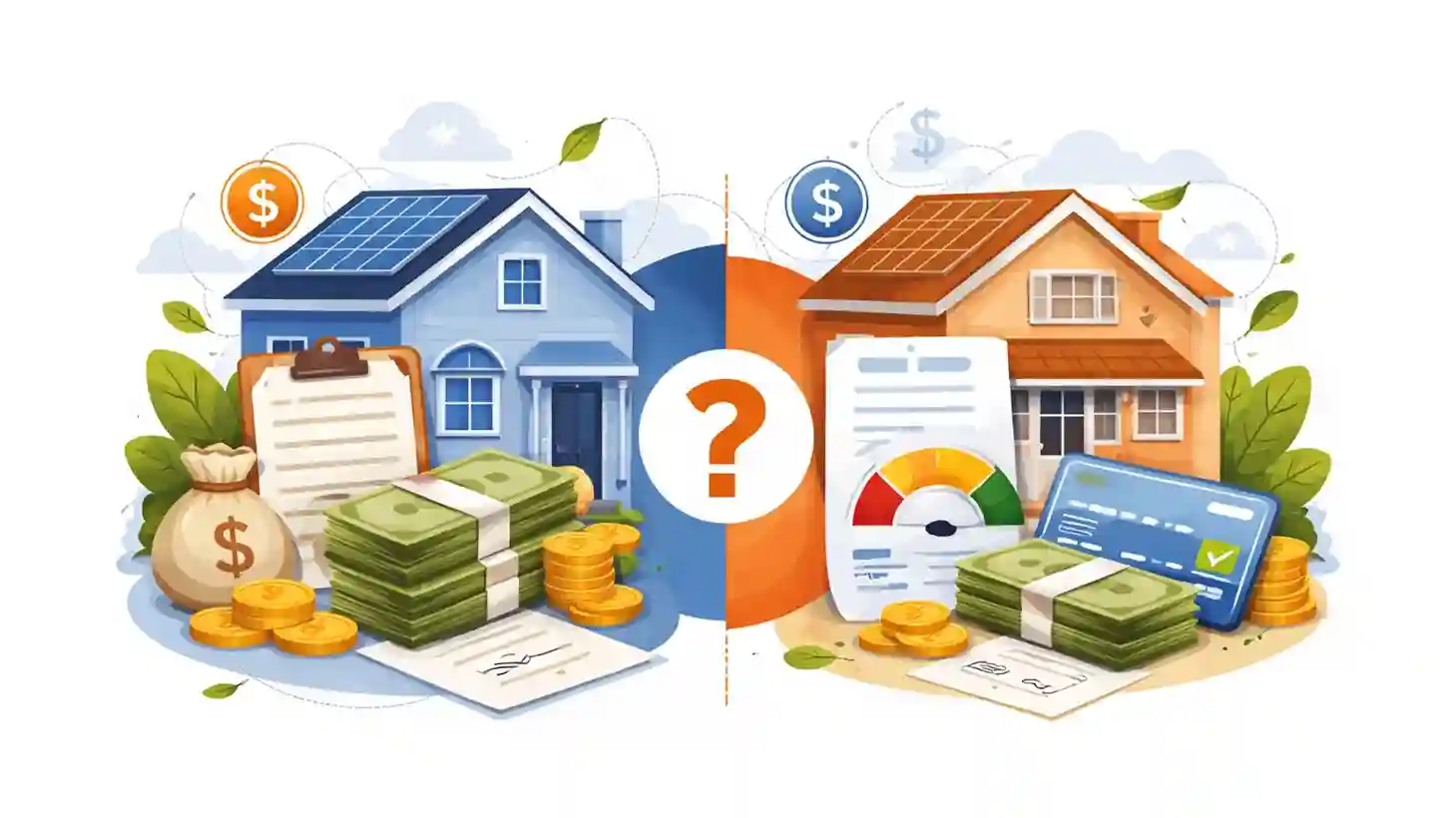
Home Equity Loans provide a single lump sum of cash with fixed interest rates and predictable payments.
-
HELOCs offer revolving credit with typically variable interest rates and flexible withdrawal options over a set period.
-
The key choice centers on certainty (a Loan) versus flexibility (a HELOC).
-
Your personal financial situation and current mortgage rates are important factors in deciding which home equity option is best for you.
-
Both options are excellent forms of home equity financing but have different risk profiles that must be considered.
Understanding Home Equity Loans
A home equity loan is similar to a regular installment loan. With this, you will receive the entire loan amount once, and then you will make the monthly loan payment with a fixed interest rate. The repayment period varies in many ways, but generally it's between 5-30 years. After the approval of the home equity loan, you will receive the whole amount at once as a single payment or in a lump sum payment when you close.
Your interest rate will be locked for the entire life of the loan, which means the loan amount will remain constant from the first month to the last. A home equity loan can be helpful for borrowers for things like home renovation, paying off multiple debts, covering an emergency expense, or covering a major event such as a wedding.
Understanding HELOCs (Home Equity Lines of Credit)
A home equity line of credit (HELOC) works similarly to a credit card. You can borrow money up to a set limit, and the balance stays open as you borrow and repay. HELOC works in two stages: a draw period (usually 5–10 years) and a repayment period (usually 10–20 years).
During the draw period, you can borrow money when you need it and only have to make interest-only payments, which keeps your costs low. After the draw period, you enter the repayment period, when you can’t borrow anymore and must start paying back both the principal and interest until the full loan is paid.
A HELOC can be risky due to the interest rate; the rate on HELOC is almost always variable, and it fluctuates with the broader interest rate environment. Your monthly payment can change even during the draw period. HELOCs are better for unpredictable or spread-out costs. Think of ongoing, multi-phase renovations, covering several semesters of tuition payments, or having a financial safety net available for unexpected medical bills or emergencies.
Pros and cons of Home Equity Loan and HELOC
Choosing between a home equity loan and a HELOC comes down to understanding what works best for you, how each option matches your needs, and how much risk you can take.
Benefits of a Home Equity Loan
-
Lump Sum: You get the full loan amount upfront to cover a large, immediate, and predictable expense.
-
Fixed Interest Rate: You know exactly what you’ll pay in interest from the start, so you don’t have to stress it if rates go up later.
Start your mortgage journey with clear guidance and real numbers. See what you qualify for today.
-
Predictable Payments: Your monthly payments stay the same, so it’s super easy to plan your budget and stay on top of your finances.
Drawbacks of a Home Equity Loan
-
Less Flexibility: If you need to borrow more, you’ll have to apply for a new loan or go through the refinancing process.
-
Higher Initial Payments: Payments are higher upfront, as both principal and interest are due from the start.
-
Immediate Interest Accrual: You pay interest on the entire loan amount immediately, even if you don't use all the funds immediately.
Benefits of a HELOC
-
Flexible Draws: Only borrow what you need, when you need it, and only pay interest on the amount used.
-
Lower Initial Payments: During the Draw Period, you usually only pay interest, resulting in lower payments initially.
-
Revolving Credit: You can borrow, repay, and borrow again for ongoing access to credit up to your limit.
Drawbacks of a HELOC
-
Variable Interest Rates: If market rates go up, your HELOC rate will rise too, which can lead to higher payments.
-
Unpredictable Payments: Monthly payments can fluctuate, making long-term budgeting more difficult.
-
The Payment Shock: Payments can jump dramatically when the interest-only Draw Period ends, and the full principal/interest repayment begins.
To calculate your home equity, estimate the current value of your property by using a recent appraisal or looking at comparable sales. Subtract the total amount you still owe on your first mortgage from that estimated value. That remaining figure is your equity, which is the foundation for all home equity financing options.
Choosing Between Home Equity Loans and HELOCs

When deciding between getting a Home Equity Loan or a HELOC, the choice should flow from your financial situation, goals, and comfort level with risk.
Choose a Home Equity Loan If You:
-
Have a large, immediate expense that requires full funding immediately (like a full-scale renovation).
-
Know exactly how much money you need to borrow and have firm quotes.
-
Prefer the stability of a fixed monthly payment and fixed rate, prioritising certainty over flexibility.
-
Using the money for debt consolidation requires the discipline of a fixed repayment schedule.
Choose a HELOC If You:
-
Don’t know the exact final amount you need to borrow (e.g., medical bills or fluctuating business costs).
-
Have to pay for ongoing, variable expenses that have spread over several years (like staggered tuition or phased construction).
-
Need a large financial safety, but don’t want to pay interest unless you use the funds.
-
You are comfortable and good at controlling your spending despite having constant access to credit.
Alternatives to Home Equity Loans and HELOCs
While these two loan options are popular to secure home equity, there are more ways available to tap into your home's cash value. You could also think about:
-
Cash-Out Refinances: This basically means you're swapping your current mortgage for a new one. You get the difference between the new loan amount and what you still owe as cash. It can be a good choice if mortgage rates are lower than your current mortgage, but keep in mind that it resets your mortgage term to the beginning.
-
401(k) Loans: You borrow against your retirement savings. The major plus is that you pay the interest back to yourself, but the downside is that if you leave your job, the loan may need to be repaid immediately.
-
Personal Loans: These are unsecured loans with fixed payments and set terms. No collateral is required, which is safer, but the interest rates are typically much higher than any loan secured by your home equity.
Conclusion
Both the Home Equity Loan and the HELOC can be powerful and smart ways to tap into the value you’ve built in your home. The right choice depends entirely on your financial situation, borrowing goals, and personal risk tolerance.
It’s important to carefully analyze the pros and cons of each option, especially since current mortgage rates can impact the fluctuating interest rates on a HELOC. For either choice, the first step is running the numbers to see where you stand financially before seeking pre-approval.
Start your mortgage journey with clear guidance and real numbers. See what you qualify for today.