How to Buy a House With Bad Credit
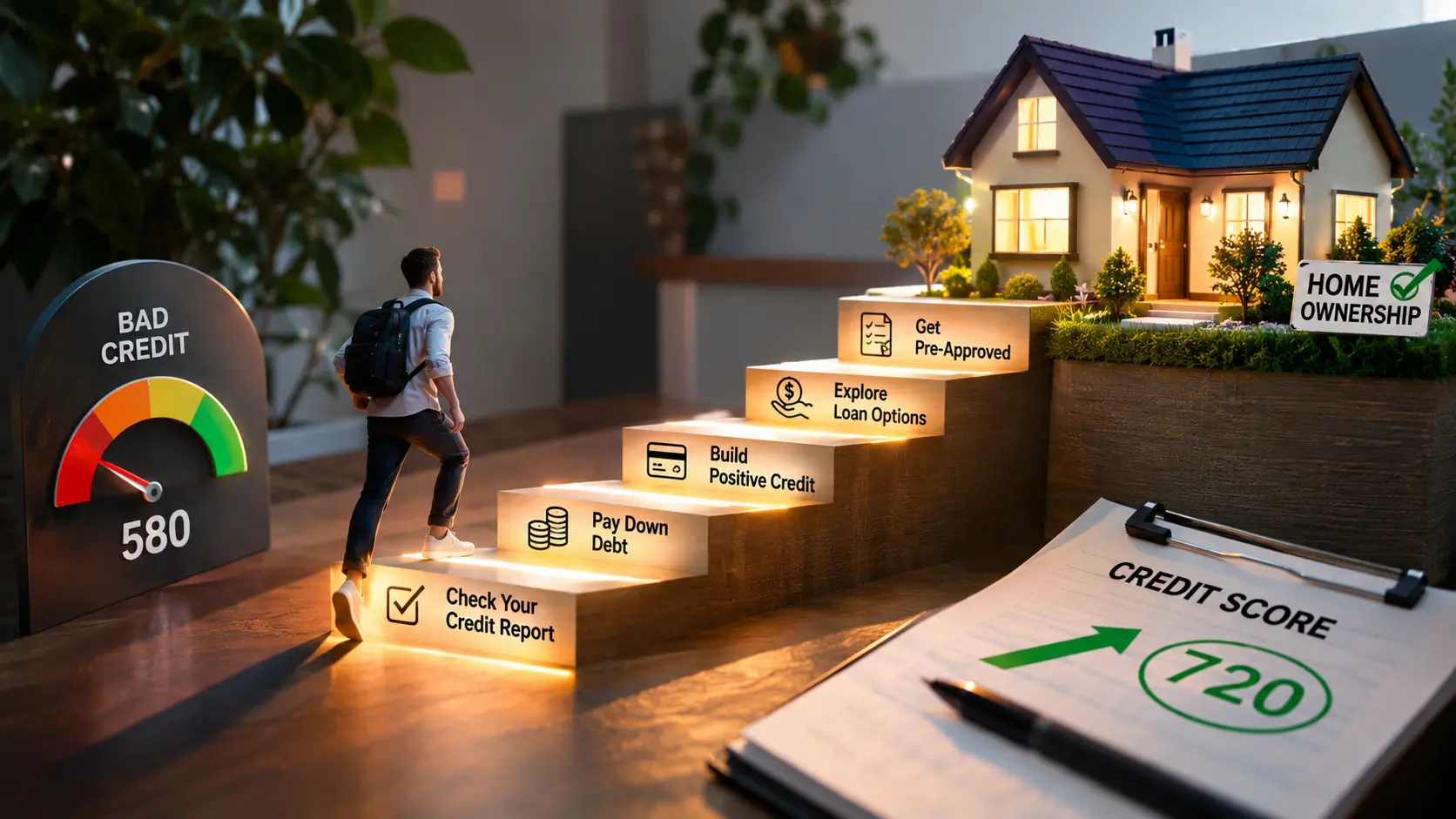
You can buy a house with bad credit. FHA loans allow a 580 credit score with 3.5% down, or a 500 credit score with 10% down, and VA and USDA loans have no minimum credit score. Expect a higher cost, so fix errors, pay down card balances, and check any bankruptcy or foreclosure waiting period before you apply.
This guide covers the credit side of buying. For the full process, start with our guide to how to buy a house.
What counts as a bad credit score for a mortgage?
A score of 579 or lower is poor, and 580 to 669 is a fair credit score on the FICO scale, and lenders treat both as higher risk. The score that counts is the one your lender pulls, which can differ from the free score on your banking app.
Lenders pull your credit from all three bureaus and generally use the middle of the three scores. Many still use Classic FICO. Since 2026, Fannie Mae and Freddie Mac also accept VantageScore 4.0 on loans sold to them, so which model your lender uses can change your number. FHA still requires reports from all three bureaus. Newer models can count rent payments when they are reported.
Having no credit score is not the same as having bad credit. A thin file can still qualify through manual underwriting, which uses rent and utility history.
Can you buy a house with bad credit?
Yes. Your score is one input, and lenders also weigh income, debt-to-income ratio (DTI), down payment, cash reserves, and how you have paid over the last 12 months. A lower score narrows your loan options and raises your cost, but it does not end the conversation.
Here is what helps an underwriter say yes to a lower score:
- Steady income: about two years in the same field or job.
- A lower DTI: less debt compared with income leaves room for the payment.
- A larger down payment or cash reserves: more of your own money in the deal lowers the lender's risk.
- Recent on-time payments: a clean last 12 months carries more weight than an old problem.
A 600 score with steady income, a low DTI, and 12 clean months can look better to an underwriter than a 650 with maxed-out cards and a new collection.
What credit score do you need to buy a house, by loan type?
FHA allows a 580 score with 3.5% down or a 500 score with 10% down, VA and USDA set no program minimum, and conventional loans no longer have a hard 620 floor in Fannie Mae's automated system. Lenders can still set stricter limits.
|
Loan |
Score rule |
Down payment |
|---|---|---|
|
FHA |
580 for 3.5% down; 500–579 needs 10% down |
3.5% or 10% |
|
VA |
No VA minimum; lenders often set 580–620 |
0% |
|
USDA |
No USDA minimum; 640 is typical for automated approval |
0% |
|
Conventional Start your mortgage journey with clear guidance and real numbers. See what you qualify for today. |
No hard DU floor since Nov 2025; 620 or more is common at lenders and PMI insurers |
3% to 5% or more |
|
Non-QM |
Set by each lender; flexible on credit events |
Typically larger |
A score below 500 is not eligible for FHA. In that case, you can either rebuild first or consider a non-QM loan. Lender overlays can also be stricter than the program, so two lenders can give two answers on the same file. For the full FHA rules, see our FHA loan requirements guide.
What is the best loan for bad credit?
FHA is usually the best starting point because it accepts lower scores, and its mortgage insurance doesn't rise as your score falls. VA is often better if you are eligible. The right choice depends on your score, eligibility, location, and cash.
- FHA loan: 3.5% down at a 580 score. Mortgage insurance is set by the loan, not by your score. The tradeoff is that it can last the life of the loan when you put down less than 10%.
- VA loan: 0% down, no monthly mortgage insurance, and a funding fee instead. It can be forgiving of past credit events once enough time has passed. You must be eligible through service.
- USDA loan: 0% down in eligible areas for households within income limits. Lenders often want about a 640 score.
- Conventional loan: possible with a strong file, but PMI cost rises as your score falls, so it often costs more than FHA at lower scores.
- Non-QM loan: for recent credit events or income that is hard to document. Expect a higher rate and a larger down payment.

How much more does a mortgage with bad credit cost?
It usually costs more because lenders price lower scores at higher rates, and on conventional loans, mortgage insurance rises too. On a $350,000 FHA loan, a rate 1 point higher adds about $237 a month.
|
Example rate |
Monthly payment |
Difference |
|---|---|---|
|
7.25% |
$2,499 |
Baseline |
|
8.25% |
$2,737 |
+$237 a month, about $2,849 a year |
That gap adds up to roughly $14,200 over five years. Assume that, FHA, 3.5% down, 30-year fixed, upfront MIP of 1.75% financed, annual MIP of 0.55%, principal, interest, and mortgage insurance only. Taxes and homeowners insurance are extra. Both rates are examples, not quotes, and your real rate depends on your full file.
To keep the cost down:
- Compare lenders: Overlays and pricing differ, so get at least two Loan Estimates.
- Pick the loan with the lowest total cost: FHA mortgage insurance is the same at a 580 score as at a 740, while conventional PMI climbs as your score drops.
- Put more down if you can: A larger down payment can lower both your rate and your monthly mortgage insurance.
- Plan for a refinance later: If your score improves and rates fall, a refinance may lower your payment. That is not guaranteed, and closing costs apply.
Test your own numbers with the mortgage calculator.
How do underwriters treat late payments, collections, and disputes?
Underwriters look hardest at your last 12 months, treat each kind of negative item differently, and often send lower-score files to manual underwriting. Knowing the rules before you apply helps you avoid surprises.
- Late payments: Recent mortgage or rent lates matter most. A clean last 12 months helps a lot, and some lenders look back 24 months.
- Collections: FHA does not require you to pay every collection. If non-medical collections total $2,000 or more, the lender must have you pay them off, set up a payment plan, or count a payment toward your DTI. Medical collections and charge-offs are left out of that test. Conventional rules differ.
- Disputes: On an FHA loan, disputed negative accounts that total $1,000 or more push an automated approval to manual underwriting. Ask your loan officer before you dispute anything shortly before you apply.
- Judgments and tax liens: These usually need to be paid or covered by an approved payment plan.
- Manual underwriting: A person reviews the file and looks for strengths that offset the credit, such as cash reserves, a low DTI, and a strong payment history. Expect letters of explanation and stricter DTI limits.
- Lender overlays: A lender can be stricter than the program, so a "no" from one lender is not always a "no" from another.
How long do you have to wait to buy after bankruptcy or foreclosure?
Waiting periods run from 2 to 4 years after a Chapter 7 bankruptcy and from 2 to 7 years after a foreclosure, depending on the loan. The government-backed loans are the shortest.
These are program minimums. Lenders can be stricter, and documented extenuating circumstances can shorten some waits. Lenders often treat short sales and deeds in lieu more favorably than foreclosure on conventional loans. After the wait, you still need to show that your credit has been re-established.
How can you raise your credit score before you buy?
Pull your reports, fix real errors, pay down card balances, bring accounts current, and avoid new credit, then keep every payment on time. Start with the steps that move scores fastest.
- Pull all three reports for free at AnnualCreditReport.com, and mark anything wrong.
- Dispute true errors with the bureaus in writing. If you have negative accounts, check with your loan officer first, because of the FHA dispute rule above.
- Pay down credit card balances. Credit utilization, your balance compared with your limit, is a big part of your score. Lower is better, and many advisors use 30% as a rule of thumb.
- Bring past-due accounts current and keep them current.
- Avoid new credit. Do not open or close accounts before you apply.
- Ask about a rapid rescore. After a documented paydown or corrected error, your lender can ask the bureaus to update your score quickly. Only lenders can request it.
- Get free help. HUD-approved housing counselors can review your credit and budget at little or no cost.
Ask your loan officer before you pay off an old collection, it may not raise your score, and some programs do not require it. And be wary of credit repair companies that charge upfront fees. Federal law generally bars them from charging before they deliver results.
What else can improve your odds with bad credit?
A larger down payment, a co-borrower, gift funds, a lower DTI, and more cash reserves all make a lower score easier to approve. Each one lowers the lender's risk.
- Co-borrower: a second borrower adds income and credit. Programs score two borrowers differently, and some use the lower score, so ask before you add one.
- Gift funds: family can often help with the down payment with a signed gift letter and proof of the transfer.
- Lower DTI: paying off a small installment loan can free up room. Ask which payoff helps most before you spend the cash.
- Reserves: a few months of savings after closing is a strong offset for weaker credit.
- Assistance programs: many states and cities help first-time buyers with down payment or credit-flexible loans. Ask your loan officer which ones fit your area.
Conclusion
Pull your three credit reports and talk to a loan officer, because a credit review shows which loan fits and what to fix first. A lower score is a reason to plan, not a reason to stop.
Rize Mortgage offers FHA, VA, USDA, conventional, and non-QM purchase loans. A licensed loan officer can look at your file and show you your options. Start your mortgage application or talk to a loan officer when you are ready.
Can you buy a house with bad credit?
Yes. FHA loans allow a 580 score with 3.5% down or a 500 score with 10% down, and VA and USDA loans set no program minimum score. Expect a higher cost, and know that lenders also weigh income, DTI, down payment, and your last 12 months of payments.
What is the lowest credit score to buy a house?
On an FHA loan, the lowest score is 500, and it requires 10% down. VA and USDA set no program minimum, though most lenders want about 580 to 640. Conventional loans no longer have a hard floor in Fannie Mae's automated system, but many lenders still require 620 or higher.
Can you buy a house with a 500 credit score?
Possibly. FHA allows a 500 score with 10% down, but many lenders set a higher minimum, and you must still meet income, DTI, and payment history rules. Below 500, FHA is not available.
How long after bankruptcy can you buy a house?
After a Chapter 7 bankruptcy, the wait is typically 2 years for FHA and VA, 3 years for USDA, and 4 years for conventional loans. After Chapter 13, FHA, VA, and USDA can allow a loan after 1 year of on-time plan payments with trustee approval, and conventional loans require 2 years after discharge.
Will a mortgage with bad credit cost more?
Usually. Lower scores get higher rates, and conventional mortgage insurance costs more as scores fall. On a $350,000 FHA loan, a rate 1 point higher adds about $237 a month, so compare offers from more than one lender.
Start your mortgage journey with clear guidance and real numbers. See what you qualify for today.