Cash-Out Refinance With Bad Credit: Can You Qualify?
 08.06.2026
Your credit score dropped, and now you need the equity in your home for debt consolidation, repairs, or breathing room and you're wondering if a cash-out refinance with bad credit is even possible.
It is. Not every lender will say yes, and the terms won't look identical to what a 760-credit-score borrower gets, but multiple loan programs are built specifically to work with lower scores.
What Bad Credit Really Means
Bad credit isn't one number; it's a range, and where you fall in that range determines which doors are open. Mortgage lenders generally group FICO scores into tiers:
- 740+: Best available pricing
- 680–739: Good pricing, minor rate adjustments
- 620–679: Approvable on most programs, but with cost adjustments
- 580–619: FHA and VA territory; conventional options narrow
- 500–579: FHA-only, and typically with a lower maximum loan-to-value (LTV)
If your score has recently dropped from where it used to be, you may still sit in one of the qualifying tiers above, you're just paying more for the same loan than you would have before. That distinction matters, because it means a bad credit cash-out refinance is usually about cost and structure, not outright denial.
How Each Program Handles Bad Credit
Conventional Cash-Out Refinance
Fannie Mae and Freddie Mac guidelines set a 620 minimum credit score for a conventional cash-out refinance, capped at 80% loan-to-value on a primary residence (lower for second homes and investment properties). Below roughly 680, expect risk-based loan-level price adjustments (LLPAs) to increase noticeably as your score drops.
FHA Cash-Out Refinance
FHA guidelines technically allow scores as low as 500, though most lenders set their own overlay for cash-out transactions specifically. FHA cash-out refinances max out at 80% LTV and require ongoing mortgage insurance premiums (MIP), but they remain the most accessible path for cash-out refinance with poor credit scenarios.
VA Cash-Out Refinance
The VA itself doesn't set a fixed minimum credit score. Approval runs through automated underwriting and, when needed, manual underwriting with residual income analysis. In practice, most VA lenders require 580–620. Eligible veterans and service members can often access up to 90% LTV, though exact limits vary by lender and state.
Non-QM and DSCR Alternatives
If your credit dipped due to a recent life event but your income or assets are strong, non-QM programs can work with scores in the 600–640 range, at a rate premium. Real estate investors have another option worth knowing about: a DSCR loan qualifies based on the property's rental cash flow rather than your personal debt-to-income ratio, which can sidestep some of the friction a low personal credit score creates.
Start your mortgage journey with clear guidance and real numbers. See what you qualify for today.
Refinance After a Credit Score Drop
A refinance after a credit score drops situation doesn't just affect approval odds, it reshapes the entire offer:
- Rate: Cash-out refinances already carry a rate premium over rate-and-term refinancing because they're higher risk to the lender. A lower score compounds that.
- Maximum LTV: Lenders often reduce how much equity you can pull out as your score falls, especially below 620.
- Mortgage insurance: On FHA loans, MIP is required regardless of score; on conventional loans, lower scores paired with higher LTV can trigger private mortgage insurance if you're above 80% LTV (though cash-out refis are typically capped at 80% to avoid this).
- Documentation: Expect closer scrutiny of the why behind late payments or a score drop, lenders read a one-time hardship differently than a longer pattern.
None of this means the loan isn't worth it. It means you should run the real numbers, including closing costs and your break-even point, through a refinance conversation with a licensed loan officer before assuming the math won't work.
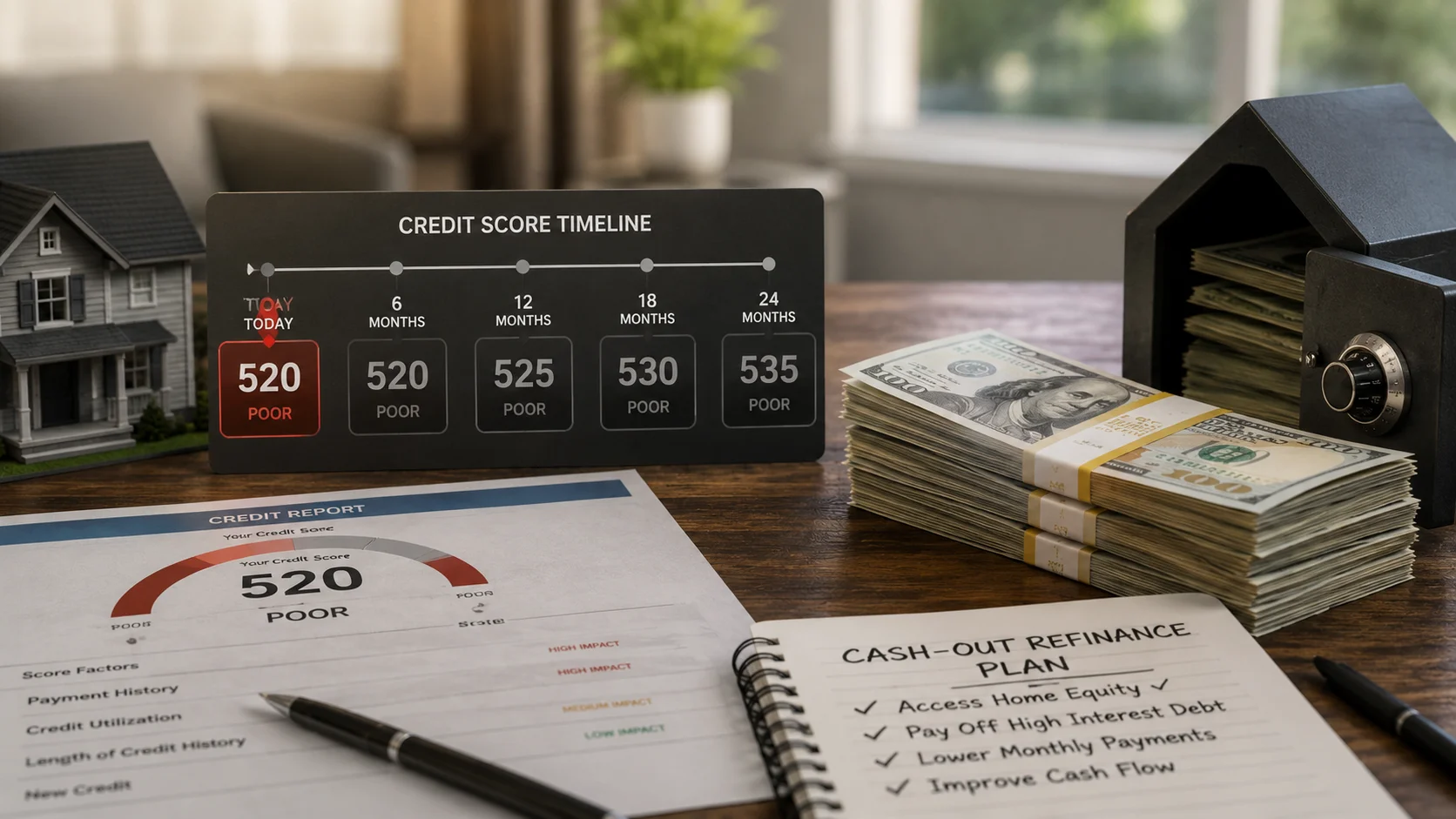
5 Ways to Strengthen a Bad Credit Cash-Out Refinance Application
- Pull your credit reports and dispute errors: Under the Fair Credit Reporting Act, you can dispute inaccuracies with each bureau for free. Errors are more common than most people expect, and a correction can move your score before you apply.
- Pay down revolving balances first: Credit utilization is one of the fastest-moving score factors. Dropping a maxed-out card to under 30% utilization can lift your score within a billing cycle or two.
- Add a co-borrower with stronger credit: Lenders typically use the lower of two scores on a joint application for pricing, but a co-borrower's income and lower debt load can offset that and improve overall approval odds.
- Build a bigger equity cushion: A lower LTV request (borrowing less relative to your home's value) can offset a lower score in underwriting, since it reduces the lender's exposure.
- Shop multiple lenders within a short window: Multiple mortgage inquiries within roughly a 14–45-day window are typically counted as a single inquiry by FICO scoring models, so rate-shopping doesn't have to cost you additional points.
Cash-Out Refinance vs. HELOC vs. Personal Loan When Credit Is Low
When your score is the limiting factor, it's worth comparing your options side by side rather than assuming a full refinance is the only path:
Cash-out refinance replaces your entire mortgage with a new, larger one, generally offering the lowest rate of the three because it's secured by a first lien position.
HELOC or home equity loan leaves your original mortgage untouched, useful if you already have a low rate you don't want to lose, though credit score requirements are often comparable to a cash-out refinance.
A personal loan requires no home equity and closes faster, but carries higher interest rates and shorter terms, making it the most expensive way to access a similar amount of cash.
How to Rebuild Equity Access After a Credit Hit
Consider a homeowner whose score dropped from 705 to 615 after a medical emergency put a collections account on her report. A year later, she wanted $30,000 from her home's equity to pay off high-interest debt entirely. A conventional cash-out refinance was priced expensively at her score. Instead, she used an FHA cash-out refinance at 75% LTV, paid a modest MIP, and rolled three high-interest balances into one lower monthly payment. Within 18 months of consistent on-time payments, her score recovered into the mid-680s, at which point refinancing again became the next logical move to remove MIP and improve her rate. This is an illustrative scenario, not a specific borrower's file, but it reflects how the FHA path is commonly used as a bridge rather than a permanent stop.
When a Cash-Out Refinance With Bad Credit Isn't the Right Move
If closing costs and a higher rate would erase most of the benefit of the cash you're pulling out, or if your score is likely to improve significantly within the next 3–6 months, it may be worth waiting. Run the break-even math, how many months of payment savings or debt-payoff benefit it takes to offset your closing costs before signing anything. A good loan officer will walk through this with you rather than push you toward closing regardless of the numbers.
Conclusion
A low credit score changes the shape of your cash-out refinance, but it doesn't automatically close the door. FHA, VA, and non-QM programs exist specifically to serve borrowers who don't fit the top credit tier, and small, deliberate steps like disputing report errors or paying down revolving balances can move you into a better pricing bracket before you even apply.
The most reliable next step is a real conversation about your specific score, equity, and goals. Talk to a licensed loan officer about your cash-out refinance options at Rize Mortgage and get a clear answer on what you actually qualify for today.
What credit score do I need for a cash-out refinance?
Conventional loans typically require a 620 minimum. FHA allows scores as low as 500–580 depending on the lender, and VA loans commonly require 580–620 in practice, even though the VA itself sets no fixed minimum.
Can I get a cash-out refinance with a 550 credit score?
It's difficult but not automatically impossible. FHA is the most likely path at that score, usually with a lower maximum LTV and lender-specific overlays. Conventional and VA options are generally unavailable at 550.
Will a cash-out refinance hurt my credit score further?
Applying causes a small, temporary dip from the credit inquiry, and your score may fluctuate slightly as your old mortgage closes and a new one opens. For most borrowers, this effect is minor and short-lived compared to the benefit of consolidating higher-interest debt.
How much equity do I need to do a cash-out refinance with bad credit?
Most programs require you to retain at least 20% equity after the cash-out (80% maximum LTV), though FHA and VA can allow slightly more borrowing in some cases. Lower credit scores often push lenders toward requesting more retained equity, not less.
Is FHA or conventional better for a bad credit cash-out refinance?
FHA is generally more accessible at lower scores and comes with mandatory mortgage insurance regardless of equity position. Conventional becomes more competitive once your score clears roughly 680, since FHA's insurance costs can outweigh a slightly higher conventional rate.
Start your mortgage journey with clear guidance and real numbers. See what you qualify for today.